
A well-defined beard collar gives a clean structure to the face, even with a modest hair density. This style of beard without a mustache runs along the jawline in a continuous line, from the left sideburn to the right sideburn, passing under the chin. However, keeping this line clean over the days requires a precise routine and some reflexes that most guides forget to detail.
Urban pollution and contour irritation: a concrete problem to anticipate
Have you ever noticed that the contours of your collar turn redder in winter? It’s not just an impression. A field study conducted by the French Academy of Barbering in February 2026 documented an increased skin irritation of collar contours related to winter pollution. Fine particles settle on the closely shaved skin and exacerbate micro-inflammations.
The solution identified by the barbers interviewed: apply an aloe vera-based balm to the side areas before shaving the contours. This gesture creates a soothing barrier that reduces blade friction on skin already weakened by cold and pollution.
If you’re looking to know how to maintain a beard collar in the long term, this skin preparation step makes all the difference between a sharp contour and an irritated area that itches for hours.
Another point to remember: since January 2026, European regulations prohibit beard oils containing more than 0.1% of certain synthetic preservatives. The 100% natural formulations that replace these products are gentler, which is particularly beneficial for sensitive skin around the beard collar.
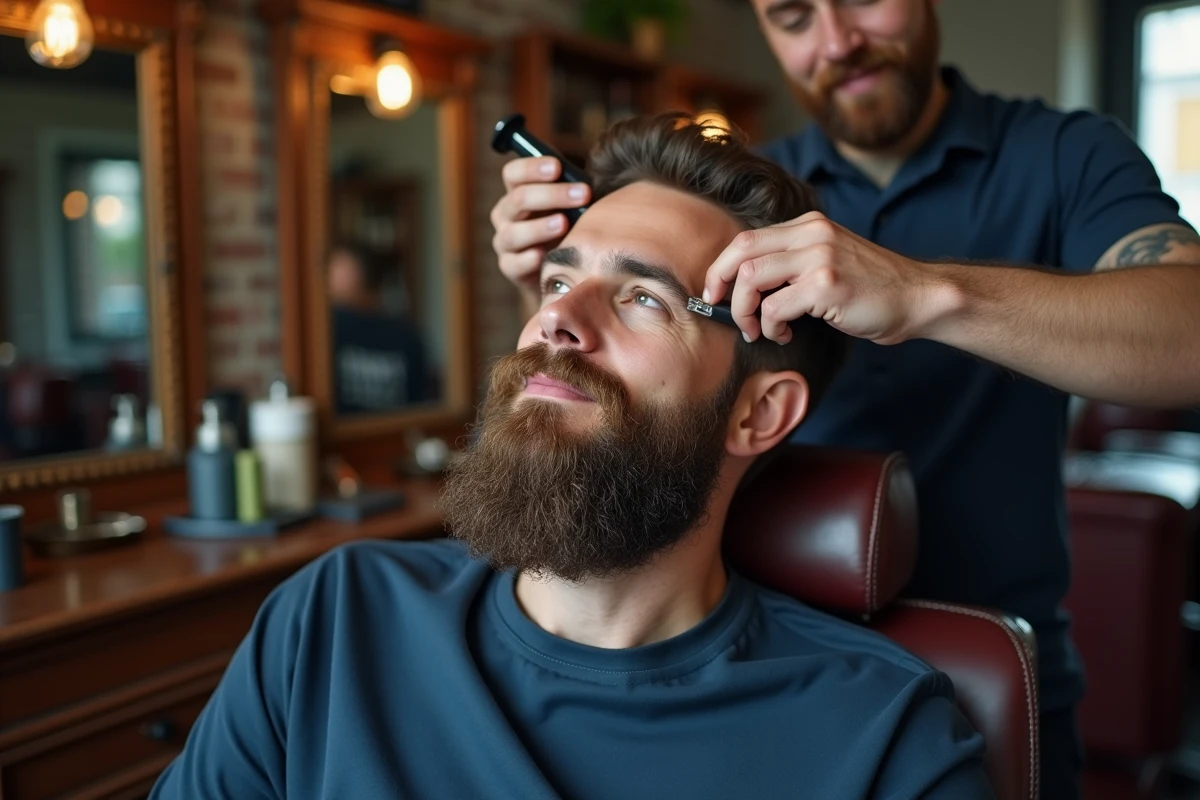
Trimmer and razor: choosing the right tool for the collar area
The beard collar is worked in two stages, with two distinct tools. Confusing their roles results in either a blurry line or unnecessary irritation.
The trimmer for the length of the collar
The trimmer is used to maintain a uniform hair height across the collar band. Set it to the same guard and run it in the direction of hair growth, from the sideburn to the chin. The movement should remain linear: zigzag motions create visible dips in the beard.
Always trim on dry hair, never after a shower. Wet hair appears longer than it is. You risk cutting too short and losing the visual density of the collar.
The razor for the outer contours
The razor (safety or straight) is used only on the areas outside the collar: the cheeks, the neck below the jawline, and above the upper lip. It is what gives the collar its sculptural and defined appearance.
- Stretch the skin with your free hand to avoid cuts on the jawline angles, where the skin changes direction abruptly.
- Shave in the direction of hair growth on the first pass, then perpendicular to the hair on the second pass if you’re looking for a very smooth finish.
- Rinse the blade after each pass: hair and foam residues reduce the precision of the next cut.
A well-sharpened razor cuts cleanly without pressure. If you have to force it, the blade is dull and will pull the hair instead of cutting it, which causes ingrown hairs along the collar line.
Maintaining the beard collar under medical treatment: adapting your routine to unpredictable growth
Men undergoing hormonal treatment or chemotherapy face irregular and sparse hair growth. The beard collar, because it relies on a continuous line, seems initially incompatible with these conditions. However, this is not necessarily the case.
According to qualitative tests conducted on two hundred men and published in the Grooming Pro Journal in April 2026, the beard collar tolerates natural asymmetries better than a three-day beard. Its continuous line visually compensates for less dense areas, where a uniform short beard style would make each gap more noticeable.
Adapting the width of the collar to sparse areas
The trick is to slightly widen the collar in areas where the density is sufficient and keep it thinner where hair is lacking. This variation in width, if gradual, goes unnoticed. A collar that is one centimeter wide on one side and two on the other does not shock the eye, provided the transition is smooth.
Avoid using guards that are too short if your growth is sparse. Slightly longer hair covers more skin and gives an illusion of density. Use the trimmer one notch above what you would normally use.
Maintenance frequency and skin care
Under treatment, the skin may become drier and more reactive. Shaving the contours every two days instead of daily reduces the risk of irritation. The aloe vera balm mentioned earlier makes even more sense here.
For areas where regrowth is slow, a pigmented beard pencil can visually fill in the gaps until the hair returns. This is not a trick reserved for professional barbers: it is a practical tool that many men use daily without anyone noticing.

Weekly routine for a neat beard collar
Rather than an improvised maintenance, a fixed routine prevents the collar from losing its shape. Here’s a schedule that works for most hair types:
- Every two days: shave the outer contours (cheeks, neck, upper lip) with a razor, preceded by a protective balm in winter.
- Twice a week: run the trimmer over the entire collar to even out the length and prevent some areas from getting ahead.
- Once a week: apply a natural beard oil (in compliance with the new European regulations) on the collar to soften the hair and nourish the skin underneath.
- After each grooming: clean the tools. A dirty guard pulls hair, a dirty razor irritates.
Consistency matters more than the duration of each session. Five minutes every two days yields a significantly better result than half an hour of catch-up on Sunday evening.
The beard collar remains one of the few styles that structures a face without requiring significant volume. Its growing popularity among men over forty confirms that a well-maintained line, adapted to one’s morphology and personal constraints, is enough to create a polished look with minimal material.