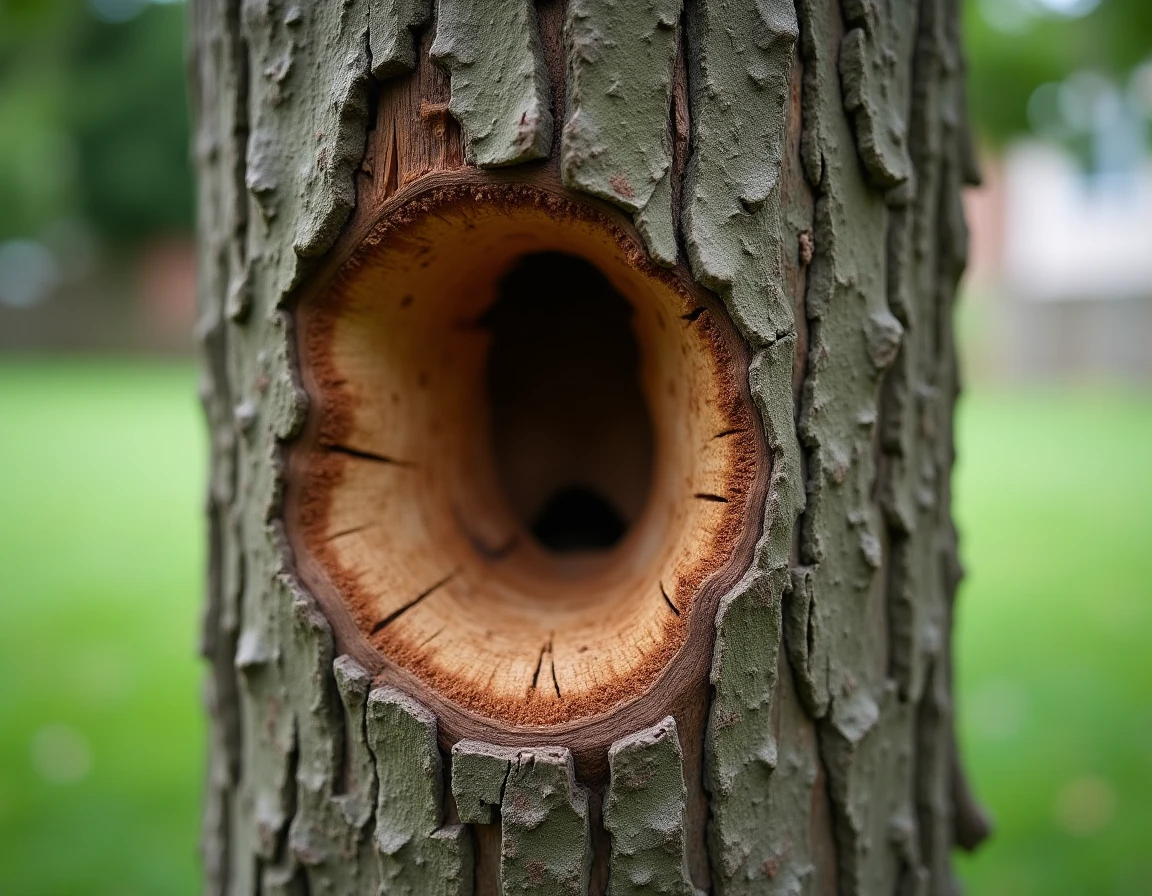
The plane tree mulberry that loses branches or whose bark is peeling is not necessarily attacked by Xylotrechus chinensis. We regularly observe hasty tree removals where the decline is due to water stress, traumatic pruning, or a wood-decaying fungus, with no signs of the tiger longhorn beetle. Making the correct diagnosis before any intervention is the first protective measure.
Differential Diagnosis: Tiger Longhorn Beetle or Abiotic Stress on Plane Tree Mulberry
A plane tree mulberry weakened by drought exhibits chlorotic foliage, marginal necrosis, and a gradual drying of the branches. These symptoms can easily be confused with the early stages of an infestation by the tiger longhorn beetle, especially when the bark begins to peel.
The difference can be seen in the wood. The larval galleries of the tiger longhorn beetle measure 5 to 6 mm in diameter, excavated along the grain and then perpendicularly. They produce fine sawdust, often visible at the base of the trunk or in the crevices of the bark. A simply stressed tree shows neither sawdust nor the characteristic circular exit holes of the adult.
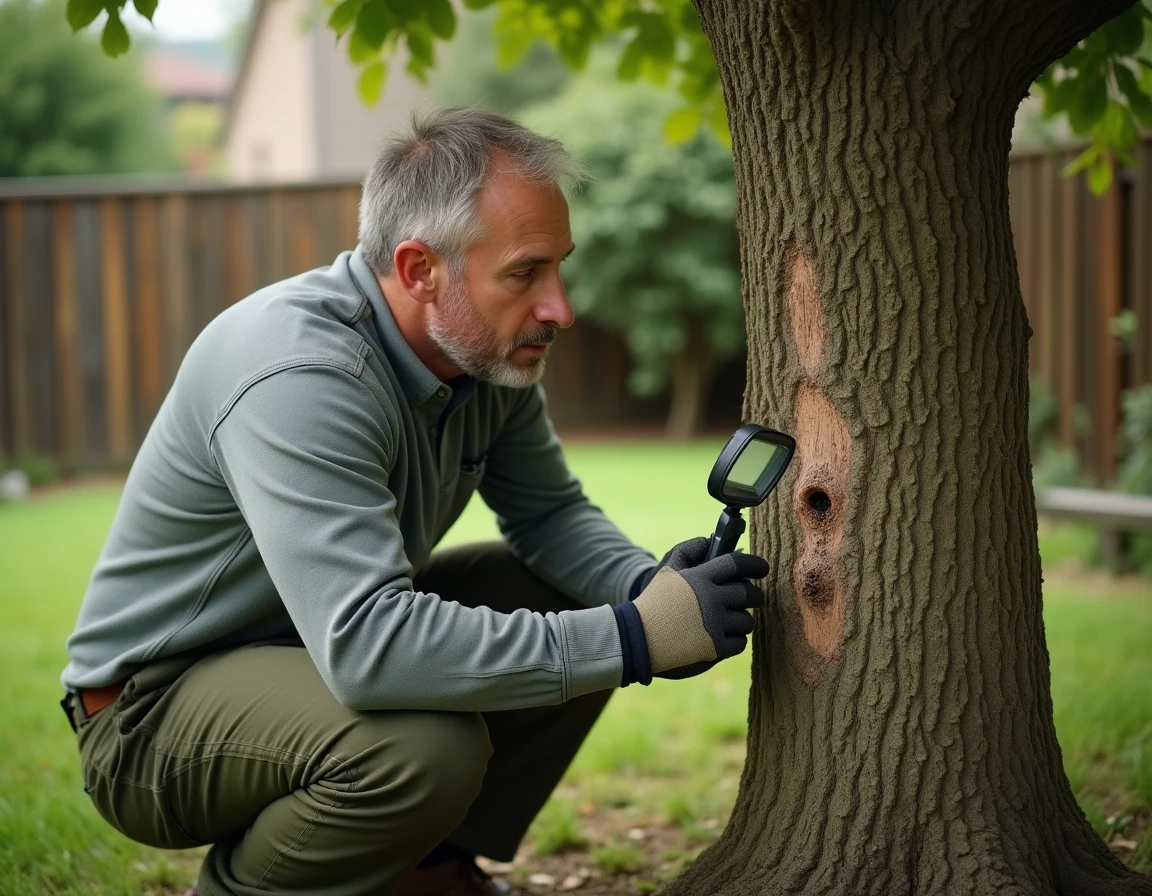
To confirm the presence of the pest, we recommend protecting a sick plane tree mulberry by starting with a methodical examination at three levels:
- Visual inspection of the bark: look for brownish sap flows, localized necrosis, and peeling in plates, which are signs of internal larval activity and not just simple dehydration of the cambium.
- Mechanical probing with a knife or gouge: superficially cut a suspicious area to locate galleries, whitish larvae, or nymphs. Healthy but dry wood contains only dry fibers with no tunnel network.
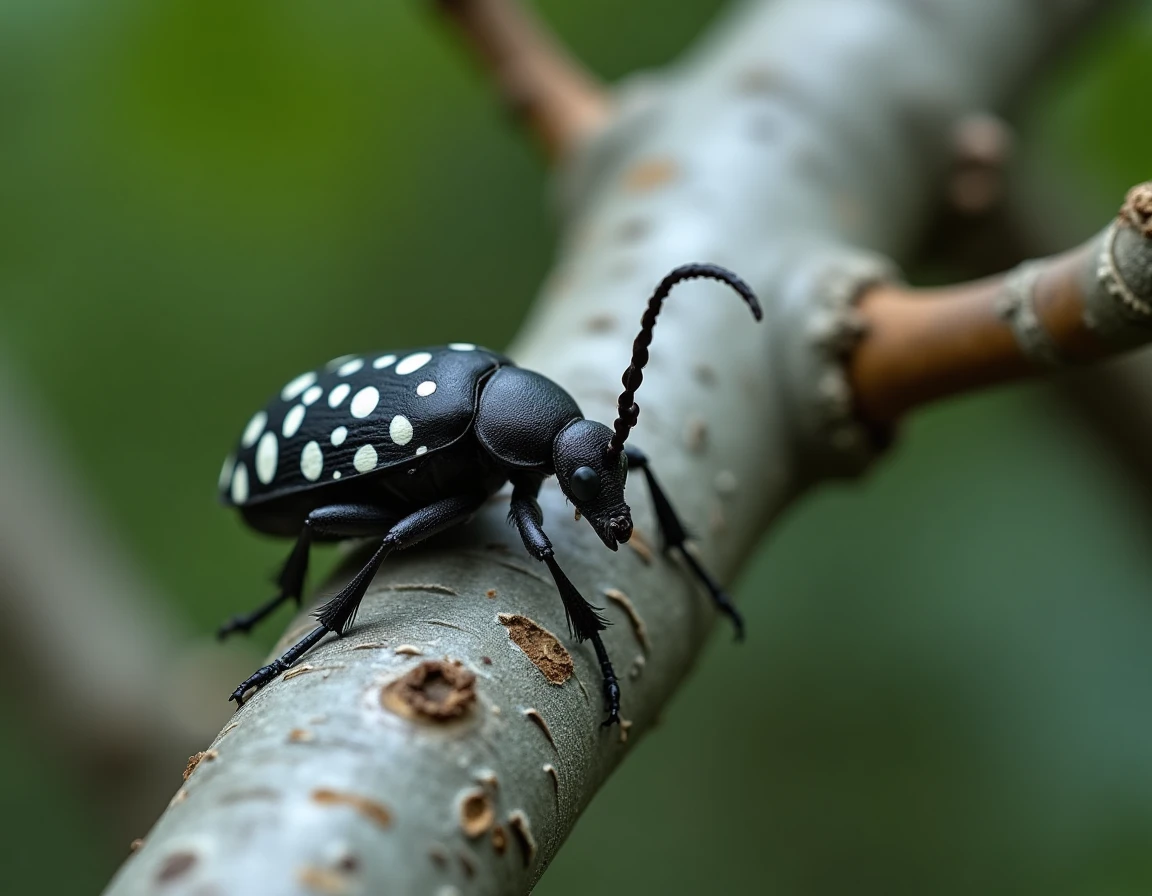
- Searching for adults between May and August: the imago measures about twenty millimeters, black with transverse yellow bands on the elytra. Its presence on the trunk or on the ground confirms an active infestation.
A wood-decaying fungus (polypore, armillaria) also produces degraded wood, but the texture is spongy or fibrous, without clear galleries. The smell of mushrooms and the presence of white mycelium under the bark indicate a fungal issue, not an entomological one.
Health Management of Plane Tree Mulberry Infested by the Tiger Longhorn Beetle
No approved insecticide can eliminate larvae already established in the wood. Curative chemical control is ineffective because the larvae develop deep in the xylem, out of reach of contact or systemic products applied to the surface.
The strategy therefore relies on mechanical action and prophylaxis.
Targeted Pruning and Felling
For a tree where the infestation is localized to a few branches, severe pruning above the galleries may suffice. We cut at least twenty centimeters below the last visible gallery, checking the section with each cut. If the wood still shows tunnels, we move back to healthy wood.
When the main trunk is colonized over a large section, felling remains the only option. A mulberry with a heavily perforated trunk becomes an unpredictable falling risk, especially since the tree may retain foliage that appears normal for several months after the larvae have established.
Destruction of Infested Wood
The cut branches and trunks must be burned or finely chipped on site. Storing infested wood in a garden amounts to maintaining a breeding ground. The larvae complete their cycle even in dead wood, and the adults emerge the following season to colonize neighboring mulberries.
This precaution also applies to firewood. Moving mulberry logs from one municipality to another directly contributes to the geographical spread of the pest, as documented in Hérault and Gironde.
Prevention and Monitoring of Healthy Plane Tree Mulberry
A healthy plane tree mulberry is more resistant to the ovipositions of the tiger longhorn beetle. Deep watering during summer drought reduces the stress that makes the tree attractive to females searching for oviposition sites. A stressed tree emits volatile compounds that some wood-boring insects use as a signal.
Pruning should remain moderate. The drastic cuts made every winter on many plane tree mulberries create entry wounds and weaken the tree’s ability to compartmentalize infections. We recommend gentle pruning, removing dead branches and aerating the crown without systematically reducing the main branches.
Community Monitoring and Reporting
The tiger longhorn beetle is classified as a provisional quarantine organism, which implies a collective vigilance obligation. Identified outbreaks in Hérault (Sète, Frontignan, Mèze, Juvignac, Cournonterral) and Gironde (Le Bouscat) show that the spread follows urban areas where plane tree mulberries are planted in alignment.
Any individual or green space manager who observes suspicious symptoms should contact FREDON Occitanie, a health organization for the plant domain. Early detection of a new outbreak allows for intervention before the pest population exceeds the management threshold.
Replanting After Felling: Which Species to Replace the Plane Tree Mulberry
Replanting a plane tree mulberry in the same location in an area where the tiger longhorn beetle is established amounts to providing a new substrate for the pest. Xylotrechus chinensis specifically targets the genus Morus (plane tree mulberry, white mulberry, black mulberry), with secondary attacks reported on apple, pear, and vine.
To maintain a similar form and generous shade, the Mediterranean hackberry (Celtis australis) or the soap tree (Koelreuteria paniculata) provide a suitable alternative for the Mediterranean climate. These species are not among the known hosts of the tiger longhorn beetle and tolerate urban heat well.
The choice of replacement species also depends on the available space and road constraints. An arborist or the municipal green spaces service can guide towards cultivars with controlled growth, avoiding future conflicts with overhead or underground networks.