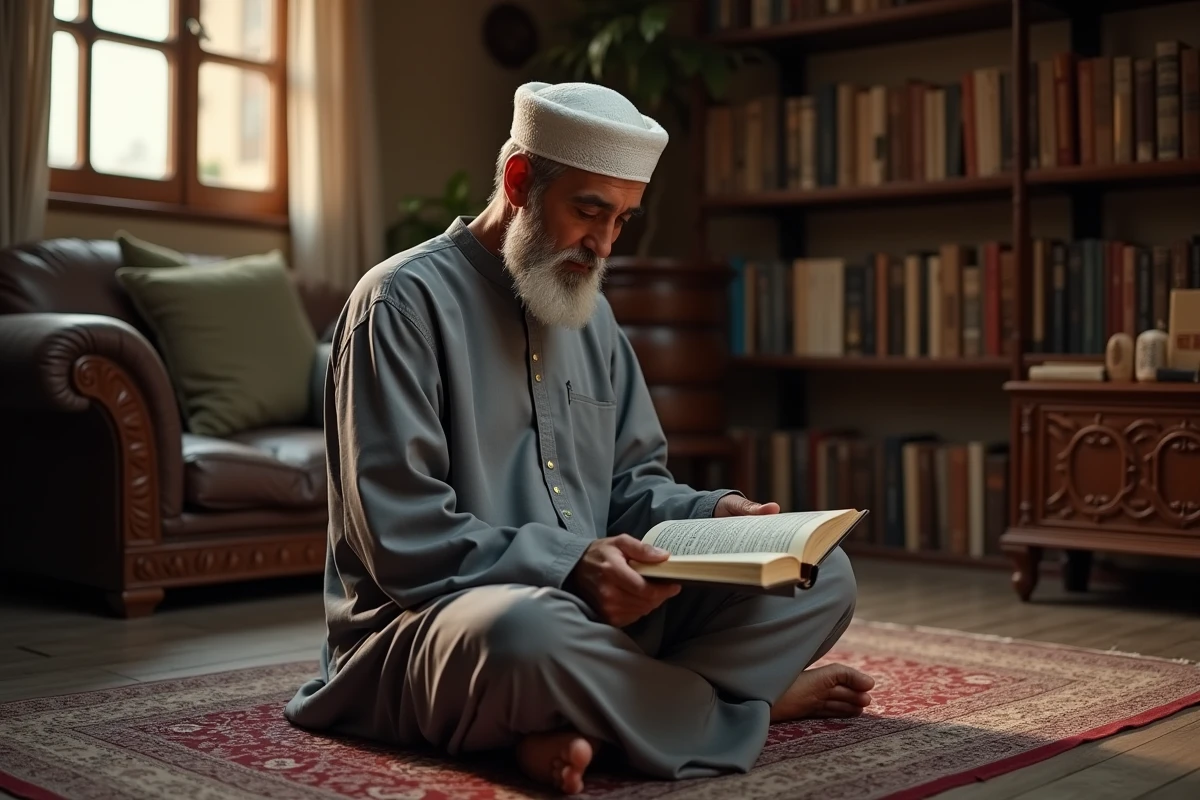
Reciting Surah Al-Mulk every evening is not a secondary ritual: the prophetic tradition makes it a spiritual shield that should not be neglected. Legal schools do not mistake this, with some going so far as to make it an essential protection against the trials of the grave.
Nowadays, mobile applications provide the text in French, accompanied by specific invocations, opening access to this spiritual heritage to a wider audience. Teachers emphasize the importance of regularity, insisting on the place of this surah in the evening routine.
Why Surah Al-Mulk is Essential in the Muslim Evening Tradition
The Surah Al-Mulk, chapter 67 of the Quran, resonates with its thirty verses in the Meccan night, carried by a rigorous and unbroken oral transmission. Recommended every evening by the Prophet Muhammad, this recitation is based on a chain of reliable hadiths, reported notably by Abu Dawood, At-Tabarani, Al-Albani, Abdallah Ibn Massoud, and Abu Hurairah. Ali, the Prophet’s cousin, ensured the transmission of this precious habit.
Thus, Al-Mulk is part of the believer’s nightly routine, echoing other surahs known for their protective qualities: As-Sajdah, Yasin, Al-Dukhan, Al-Waqi’a, Al-Insan, Al-Burûj. It structures the evening prayer, accompanies the dhikr, and finds its place in the calm of rooms where words become invocations. This text revealed in Mecca addresses divine sovereignty, the meaning of life and death, individual responsibility, the promise of paradise, and the reality of hell.
The reading and meditation on Al-Mulk go beyond mere routine recitation. They become living practices, renewing the believer’s connection to the Quranic Word. Today, the French translation fully integrates into this approach. The practical guide for the evening prayer proves useful for incorporating each verse into the nightly routine and appropriating the strength of the transmitted invocations.
Here are the key points to keep in mind:
- Surah Al-Mulk appears in several reference hadiths, foundational to the nightly practice.
- Its recitation every evening structures spiritual life and reminds of Allah’s absolute sovereignty.
- Comparing Al-Mulk with other surahs illuminates the coherence of the protection sought at nightfall.
What Spiritual Benefits and Protections are Associated with Its Regular Recitation?
Reading the Surah Al-Mulk every evening is not just about warding off the fear of the night. It is also about arming oneself against the unknown of the afterlife. Hadiths emphasize that this passage from the Quran protects from the punishment of the grave, offering the believer the serenity that so many Muslims have sought throughout the ages. This text questions Allah’s total sovereignty, human vulnerability, and the relationship with creation.
But Al-Mulk is not merely an automatic protection. It shapes the believer’s spirituality, stimulates consciousness, and invites reflection on life, death, and what comes after. The evocation of paradise for some, and hell for others, gives particular depth to the idea of divine justice. Mercy and forgiveness are omnipresent; each verse recited is a sincere request addressed to Allah’s clemency.
Among the benefits highlighted by tradition, we find:
- Protection from the punishment of the grave: This promise, firmly rooted, gives the surah a special place.
- Strengthening of faith: The recitation encourages submission to Allah and reminds of individual responsibility.
- Obtaining forgiveness: The believer, through each verse, seeks divine mercy.
Al-Mulk engages both the mind and the heart. There is no need for eloquence or performance, but rather a genuine sincerity in invocation and coherence between the recited words and personal commitment.

Practical Tips: Integrating the Reading of Al-Mulk and Evening Invocations into Your Daily Life
Incorporating the reading of Surah Al-Mulk into the nightly routine is not about automation or a strict rule. The idea is to transform this moment into a lived appointment, at the intersection of night prayer and dhikr. The French translation, now at hand, helps everyone grasp the depth of the text, appreciate its significance, and anchor the Quranic Word in the reality of each evening.
It is wise to start gradually. Allow yourself a few minutes in silence before falling asleep. With a calm mind, read the surah first in Arabic and then in French. This alternation allows for understanding and integrating the meaning without rushing. Place the reading of Al-Mulk at the heart of your nightly habits, linking it to the traditional invocations recommended by the sunna.
To guide you, here are some concrete tips:
- Recite the surah after the evening prayer (isha) or just before going to bed.
- Combine this reading with invocations for protection, forgiveness, and gratitude.
- Take time to meditate silently on the meaning of the verses.
The most crucial aspect is regularity. This evening appointment, encouraged by tradition and reliable hadiths, shapes a presence to oneself and to God, continuing the spirit of Islam: peace, openness, respect. Al-Mulk every evening is the promise of a peaceful heart that sleeps, and a mind that remembers.